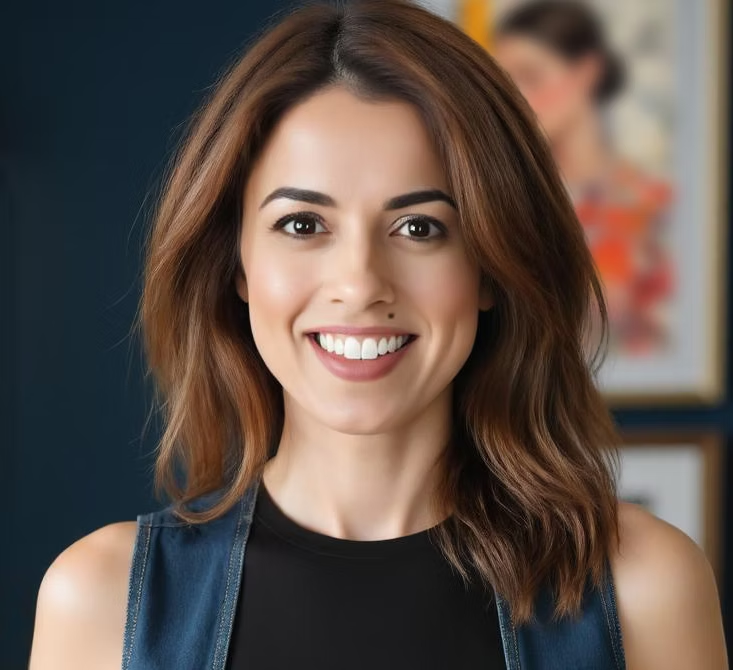
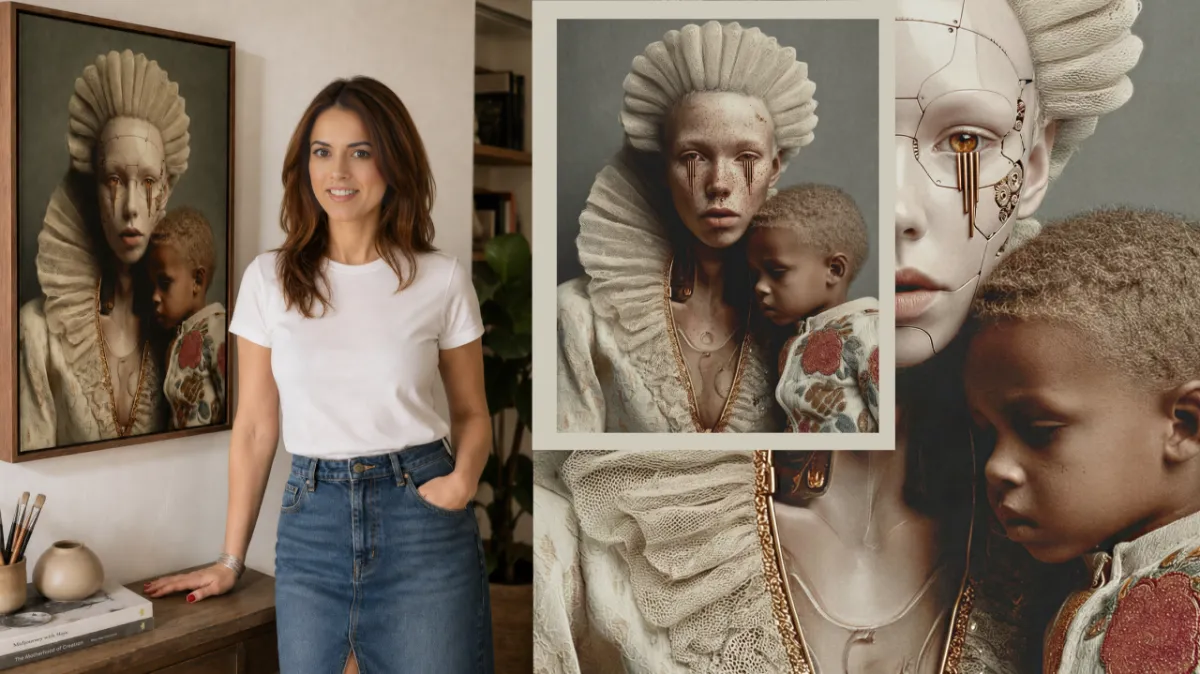
Maya Elav Nachshon is a multidisciplinary AI artist and visual storyteller whose work finds human resonance at the intersection of roots, femininity, and technology. The current discourse surrounding the future of creativity often converges on a question she finds somewhat narrow: Is Artificial Intelligence a tool, a partner, or perhaps an independent creator? As these systems reshape our workflows, it is becoming clear that the real question is far broader. It is a sociological and philosophical inquiry: What remains of the creator's identity when the machine can statistically mimic her gaze to perfection?
In an era where the pixel has become a cheap, ubiquitous commodity with zero economic weight, we are witnessing a profound anxiety within the art world. This dread doesn't stem from the mere use of a machine, as we have worked alongside machines since the Industrial Revolution. It stems from speed and scale. In Photoshop, automation crept in over decades, hidden beneath the hood. In AI, the shift is instantaneous, and the machine no longer hides. It flaunts its contribution, forcing us to confront the question of creative sovereignty here and now. Our struggle isn't just with the machine's capability, but its visibility. Unlike previous tools that operated behind the scenes, generative AI places automation at the "front door," demanding we address the issue of ownership immediately, not incrementally. Consequently, the value of the work shifts from the final output to the journey, to the personal navigation through an infinite sea of possibilities.
From Legal Paternity to Creative Motherhood
To understand the depth of this shift, we must examine the terminology we use. In legal and academic spheres, the standard term for ownership of a work is "Paternity Rights." It is a clinical, cold concept, focused on dry ownership and the legal attribution of a product to its producer. In the generative studio, however, this term feels hollow. Nachshon chooses to replace it with "The Motherhood of Creation."
This choice is deliberate. Motherhood symbolizes a long process of nurturing, cultivating, and raising within a responsive and complex environment. It reflects the intimate dialogue, the "ping-pong" or the dance with the machine, where we grow the image step-by-step. Motherhood is the recognition that a work is not a momentary button press, but the result of intention invested over time. The machine is the studio; we are the sovereigns within it. It is crucial to understand that this is not a partnership of equals, but what academia calls a "multi-agent environment." In this space, the machine is merely the field; we set the rules, and the responsibility for direction and essence remains entirely with the guiding mother.
Between the "Slot Machine" and the Creative Studio
When Nachshon is deep in the creative process, in a dense dialogue with the machine, it politely offers the "average." It delivers an aesthetic image, clean, flawless, and devoid of truth. The model emerging from her work in the field suggests a critical conceptual shift: moving away from using AI as a "slot machine" and toward managing a creative studio.
In this studio, sovereignty is not determined by "who created the pixels," but by "who controlled the process." This isn't a binary state, but a spectrum of creative authority: a work created with a single simple prompt represents Weak Sovereignty, whereas a work born from a complex, iterative process represents Strong Sovereignty. The tighter the control, the more distinct the motherhood.
The Five-Agent Architecture: Motherhood as Methodology
The "Loop" methodology deconstructs the nurturing process into five stages, each leaving the footprint of human intention. Stage one is Staging: it begins with a blueprint. This is the moment of transforming an abstract idea into a set of intentions and constraints. The goal is to shrink the model's "guessing space" by defining the scene, lighting, and composition in advance. When Nachshon asks to blend the softness of human skin with a cracked texture, she is the director setting the stage before the machine begins to render.
Stage two is Generating: the machine churns out drafts in bulk; they are cheap in terms of effort. The greatest pitfall in current discourse is the "Draft Trap," where most people stop when an image looks "good enough." This is why so many outputs remain generic, carrying that unmistakable "scent" of the machine. To Nachshon, the draft is merely raw material, the clay from which the statue will be carved.
Stage three is Curating: this is where humanity reveals itself through selection and refusal. The machine can generate variations forever; the moment of saying "no" to statistical kitsch is the moment of birth. Here, creative sovereignty is expressed through an aesthetic conscience. As a curator, Nachshon applies rigorous judgment: Does the image align with the intent? Is the style precise? Does the composition work? She looks for "deal-breakers," anatomical distortions or visual noise. Much like a gallery curator extracts a story from endless works, we navigate the generative space to find the image where statistical "probability" becomes a private truth connected to our memory.
Stage four is Refining and Processing: here, we move into targeted editing, often blending classical and modern tools. This is the stage where Nachshon injects the "flaw" into the sterile aesthetic, fighting the machine's tendency to smooth everything over. It is a process of digital "color mixing" until achieving the exact tone stored in memory. Stage five is Documentation: we are approaching a time when we will need "receipts." In an era where tech giants dictate the legal tone, creating isn't enough, we must document to prove intent. While the commercial world views documentation as cold "protection" for corporate interests, for us, it is something else entirely. Our "receipts," the prompts, the change logs, the discarded versions, are the "vaccination records" or the travel log of the work. They prove a journey of intention took place, transforming what could be a bureaucratic nightmare into living testimony of our sovereignty.
The Language That Remains
We do not value the machine for its ability to produce by the millions. We value the human effort that harnessed it to tell a story worth hearing. AI is not an independent artist; it is a multi-tool environment. This forced partnership requires us to be more present, more aware, and more critical.
The day may come when we must present these "receipts" for legal or commercial recognition. But beyond the dry law, this documentation is the evidence of our journey. It is the proof that we didn't just push a button, we raised, navigated, and loved the work until it became ours. The eye will always know the difference between a random click and a creation that has a mother.