
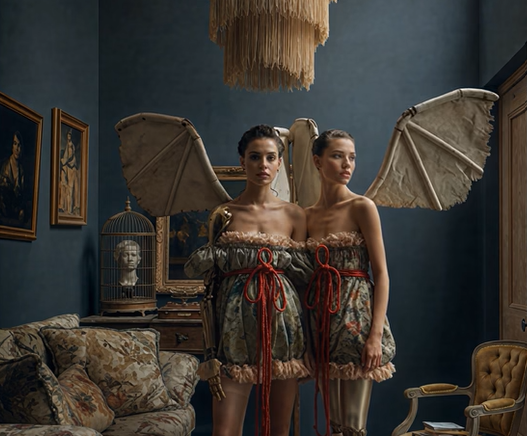
Maya Elav Nachshon is a multidisciplinary AI artist, Prompt Magazine curator, and speaker and educator in the field of visual storytelling with artificial intelligence. Her latest series, Emulated Realms, explores a question that interests creators and content professionals alike: what happens when you move a human subject from the isolated portrait into the environment that shapes it?
From Portrait to Habitat
The latest work in the series, "The Sisters," demonstrates the central idea. The figure is no longer presented as separate from a uniform background but as part of an environment that carries meaning. This shift, which Nachshon describes as "moving from the isolated portrait to the habitat it occupies," is both an artistic statement and a technical change in how she uses AI tools.
With tools like Midjourney for creation, Magnific AI for detail refinement, Topaz Labs for quality enhancement, and krea.ai for real-time adjustments, Nachshon builds layered visual narrative that could not be produced without AI and cannot be produced with AI alone without deep human direction.
AI as a Tool for Emotional Discovery
One of the defining characteristics of Nachshon's work is her choice of subjects that touch roots, femininity, and memory. In her work, AI is not the goal but the means to explore experiences that are difficult to express in words. The Emulated Empathy series she develops in parallel extends the idea: even the machine can become a conduit for life and empathy.
This approach raises a question relevant beyond the art world: how much of the message depends on the tool, and how much depends on the person holding it? Nachshon's AI produces images, but the story lives in the choices she makes before and after pressing Generate.
Visual Storytelling Language as a Business Skill
What Nachshon does in art touches directly on marketing, content, and branding professionals. The tools she uses, Midjourney, Magnific AI, krea.ai, are no longer reserved for artists alone. They are becoming part of the creative infrastructure of organizations that want to produce fast, personal, and differentiated visual materials.
The difference between basic use of these tools and use that creates real value is the same difference Nachshon identifies in her work: not the technical prompt but the question behind it. What do we want to say? To whom? And why now?