
Doron Tsur is a screenwriter, content creator, and AI processes lead at Overwolf. He is one of Israel's prominent creators who applies AI tools in daily work, and in a recent post he shared how he turned a repetitive technical process into an almost instant action.
What Doron Tsur Changed in His Content Creation Process
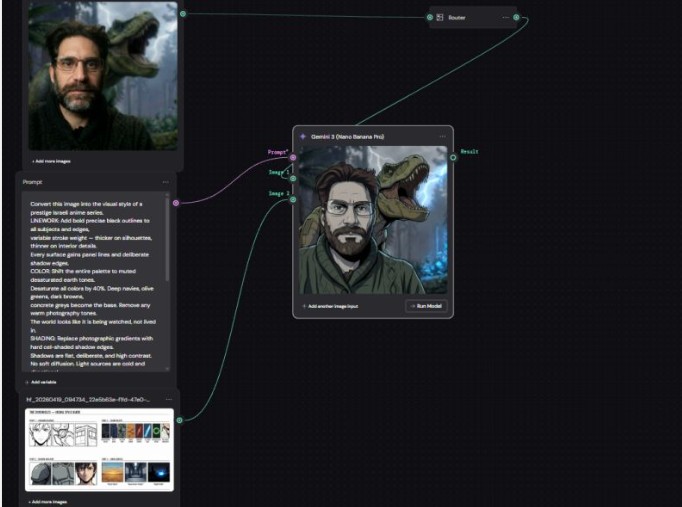
While working on a trailer for a series, Tsur needed to convert a large number of real-world images into a fictional visual style he had created. Until recently, every such conversion required him to copy a fixed prompt, paste a style sheet that explains the desired style to the model, add the image, and click a button. About two minutes per image.
The problem was not the quality of the result but the volume. When producing a full series episode, you are dealing with dozens and hundreds of images, and every two minutes adds up to hours of repetitive work.
Why a Fixed Workflow Beats a Prompt That Repeats Itself
After attending a Figma Weave workshop at the Creatives & Conversions conference in Tel Aviv, Tsur realized there was a simpler way. Instead of running the same manual sequence each time, you can build one workflow that contains the prompt, the style sheet, and all the settings in advance.
The essential difference is between a task you perform from scratch every time and a process built once that waits ready for use. Once all the instructions are packaged, all that remains is to feed in the image and receive a result.
How Figma Weave Turned a Two-Minute Process Into Ten Seconds
Using Figma Weave, Tsur built a workflow that holds all the conversion details and stays available for him on the platform. This turned a roughly two-minute process into a ten-second action, without giving up control over style or quality.
The saving sounds small until you multiply it by hundreds of times. For a creator working on a large project mainly in the evenings and on weekends, such a shortcut is the difference between a project that moves forward and one that stalls. The automation does not change the final result, it removes the friction that slows the work.
What This Means for Creators and Content Teams
The lesson Tsur presents is relevant far beyond image conversion. Any creative task that repeats itself in the same way is a candidate for automation, and visual tools like Figma Weave make it possible to build such processes without coding knowledge.
The question creators and content teams need to ask is not only which AI tool to choose, but which actions they repeat again and again. There, in the recurring sequence, hides most of the time that can be returned to the creative work itself.