
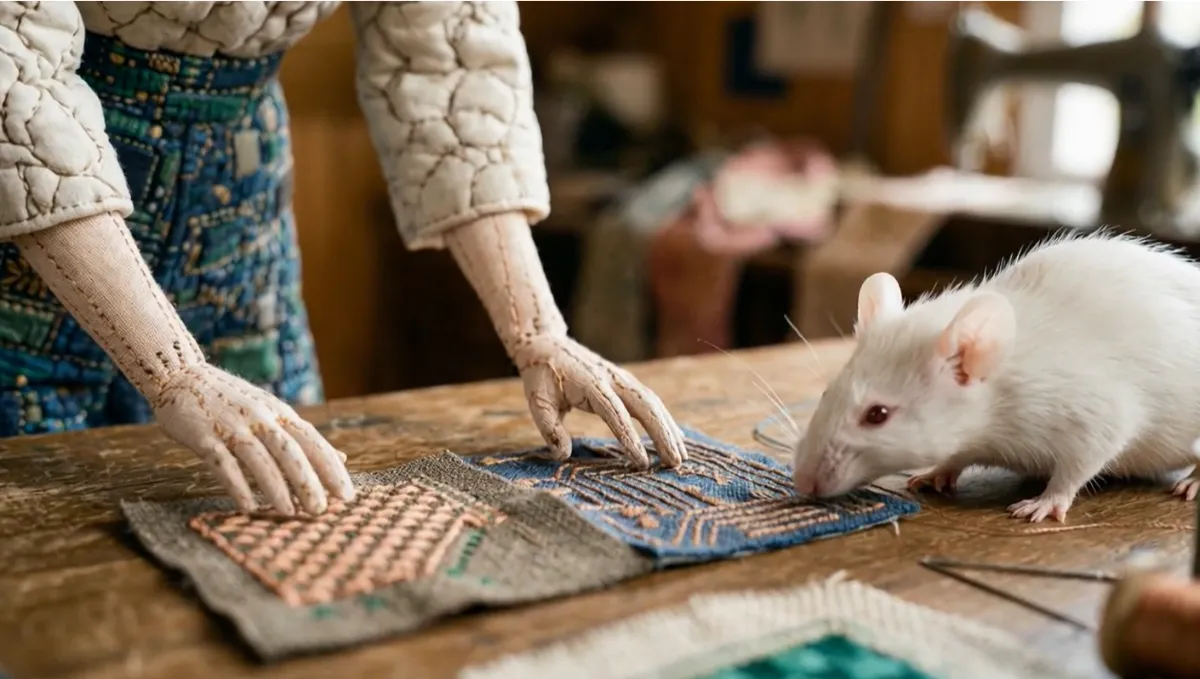
Efrat Yamin is a Creative-AI Solutions Specialist and Art Director with 18 years of experience who lectures to organizations on practical work with generative AI tools. In a recent post she described a discovery that emerged from her own process: building a character in MidJourney became, at a certain point, a question of rules rather than technique.
The Moment the Prompt Stopped Being a Question of What
Yamin described a specific transition: at some point in her process, she stopped asking how the character looks and started asking what it is made of, what is allowed and what is not. That is the distance between prompting and working with material. When working with fabric, you do not simply decide. You respect what the material permits.
A stitch is a rule. A pattern is a system. When you stop seeing MidJourney as an image generator and start seeing it as a material with its own constraints and properties, the nature of the work changes entirely.
What Becomes Visible When Technical Friction Disappears
Yamin observed something that sounds paradoxical: the more AI removes friction, the more creative professionals seek it elsewhere. Texture, imperfection, process. Not from nostalgia but from a need for grounding.
When a tool can produce almost anything, the question shifts from what is possible to what is right. The decision about constraints, about what to include and what to leave out, is precisely what transforms output into intentional design rather than random noise.
Not Human vs Machine but Structure vs Chaos
Yamin reframed the question that many creative professionals ask. The right debate is not whether AI replaces artists but what happens when a powerful machine operates without a framework. Her answer: chaos. A powerful tool without clear conceptual structure produces outputs that look impressive but lack identity.
As tools grow more powerful, structure becomes more important. This conclusion is not surprising to those who come from a background in traditional design, but it challenges the assumption that AI proficiency means production speed.
What This Means for Creative Professionals Entering the AI Space
The experience Yamin describes points in a clear direction: skills that come from traditional training in design, photography, directing, and art are not outdated in the AI era. They are the foundation that enables working with AI tools in a way that produces consistency and quality, not just volume.
Someone who knows how to define a character, build a visual system, and decide what is allowed and what is not brings to AI tools the structure they need to produce results that feel intentional. That is a skill AI itself does not generate, but one that multiplies its value.