
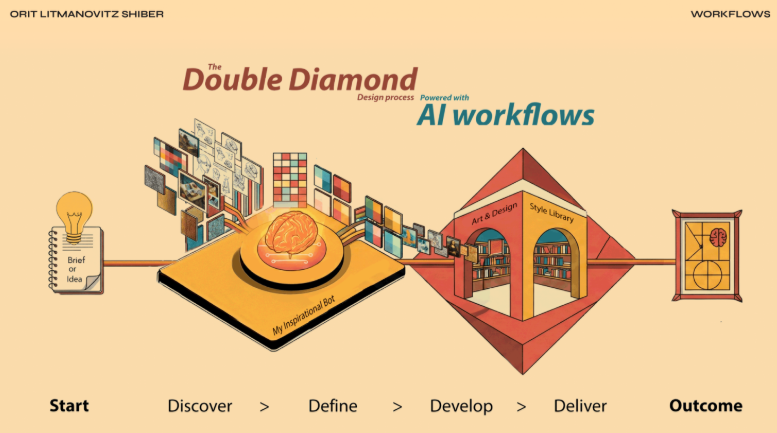
Orit Litmanovitz Shiber is a content creator and lecturer specializing in AI and creative workflows. In a LinkedIn post, she describes the process of creating an ad for the Institute for Democratic Resilience at Beit Berl, under difficult conditions: two weeks into the war with Iran, children in the background, a frozen timeline, and a clear sense that things were not moving forward.
What is the Double Diamond Process in AI-Powered Creative Work?
Orit works according to the Double Diamond method, a design framework that divides creative work into two main phases. The first phase is understanding: research, references, language refinement, and storyboard development. The second phase is creating. As she puts it, creative work means breathing twice: once to understand and once to create.
When AI is integrated into this process, each phase receives different support. In the research and language refinement stage, AI helps accelerate and focus the work. In the creation stage, it generates assets at a volume and speed that was previously impossible. On paper, this sounds like a solution to most creative challenges.
What Happens When Methodology Is Not Enough?
Orit had prepared everything by the book: research, references, a ready-made prompt list. And yet the timeline was stuck and the film was not progressing. This was her uncomfortable realization: even when working with AI and a structured methodology, it is still possible to get stuck precisely at the stage where you need to create.
A creative block does not disappear just because a process exists. It persists even with the right tools, the right experience, and a hard deadline. This insight is a turning point for anyone integrating AI into creative workflows.
Collaboration as a Solution to Creative Blocks
Instead of trying to create better, Orit made a different move. She found an experienced creator who could generate a large volume of assets quickly. That collaboration broke the logjam, not because the tools changed, but because the human dimension of the process received reinforcement.
Even after finding a direction, the next step was not to create from scratch again. It was to let go of her own timeline, work from the rough cut her collaborator had made, and do only one thing: cut, refine, and choose.
Choosing is the Core of Strong Creative Work
The conclusion of Orit's story is also her central statement: the film is not the best she could have created. It is the best she could have chosen, given the time she had. In a process where AI can generate dozens of versions, the act of choosing has shifted from a technical step to the heart and essence of the work.
Strong creative work, according to Orit, does not belong to those who produce the most or the fastest. It belongs to those who choose most precisely, even when there is no perfect option, even under time pressure, and even when conditions are far from ideal.