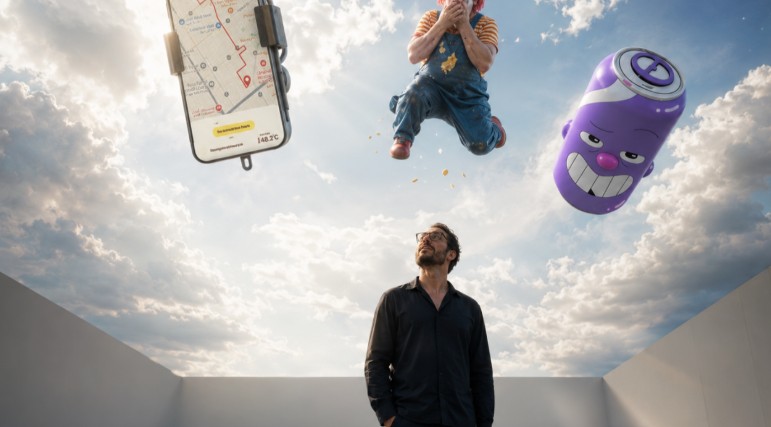
Omri Marcus, a creator and creative voice in advertising, describes a shift that just happened. For years what stopped sharp ideas was never a lack of creativity. It was the distance between imagining something and making it real. That distance, he says, is gone.
What has changed about creative production in the age of AI?
For years the machine that produced campaigns was always slightly slower than the imagination feeding it. Budget, timeline, and risk turned bold ideas into compromises.
Now the order has flipped. What is left is the idea and the person willing to act on it. Three real cases make this concrete.
How did Popeyes respond to a McDonald's move in three days?
Popeyes has roughly 4,500 locations, McDonald's has ten times that. The day after Popeyes launched its Chicken Wraps, McDonald's brought back the Snack Wrap, a product that had been off the menu for nearly a decade. Popeyes decided to treat it like an act of culinary war.
There were two options: three weeks and a six-figure budget for a response that would land after everyone had moved on, or a faster machine. The team chose the faster one. Filmmaker PJ Accetturo scrapped all his work with less than three days left and switched to Veo 3 for video and Suno for sound.
The result was a cinematic diss track that hijacked McDonald's own media moment. The budget was effectively zero, but the reach was not, with 3.1 million views on TikTok alone. The real story is not the cost, it is the timing. For the first time, a creative idea moved faster than the machine built to slow it down.
What did AB InBev do with abandoned shopping carts?
Seventy percent of online carts get abandoned, and the industry answer for three decades has been the same reminder email nobody reads. AB InBev built something different around a documented psychological truth: people regret the things they did not do far more than the things they did.
Its TaDa Delivery app in Mexico is built around the culture of the juntada, the spontaneous get-together that becomes a story. When someone abandons a cart of Corona, ice, and charcoal, they are not just leaving products behind, they are leaving a night behind. Twenty-four hours later their phone buzzes, not with a reminder but with a personalized animated video predicting the exact night those items could have created.
Three AI systems worked together, language generation, image generation, and custom voiceovers via ElevenLabs, producing unique videos in real time. The outcome was 400 percent more clicks and 16.5 percent more completed purchases. The abandoned cart stopped being a missed transaction and became a missed memory.
Why did HungerStation build a feature instead of an ad?
No ad, no script, no hashtag. HungerStation looked at its riders working through 55-degree Celsius Saudi summers and built the Shaded Route, an AI that tracks the sun's angle in real time, analyzes satellite imagery of Riyadh, and reroutes every delivery through the coolest available path.
Being in the shade feels up to 15 degrees cooler, and the deviation from the fastest route stays within 10 percent. Every day 3,000 riders use it, and every day 114,000 kilometers are covered in the shade. Rider applications rose 8 percent and retention rose 20 percent.
The feature itself was the campaign. HungerStation's brand promise is "Before Everyone," prioritizing the people most often overlooked. Someone decided that living up to that promise was more creative than advertising around it, and they were right.